
Certificate verification
Every ACLAS award carries a unique certificate ID. Anyone holding that ID — an employer, an admissions office, an immigration authority — can confirm the award through a free public lookup.
Hague Convention authentication
An apostille authenticates the signature and seal on an academic document so that it is legally valid outside the country that issued it. ACLAS arranges this for its degrees and transcripts under the Hague Convention.
What it does
Details
Important information
These details explain what the service covers, including its limits and conditions.
ACLAS offers seamless Apostille certification for your degrees and transcripts, ensuring global recognition in over 120 Hague Convention countries for education, employment, or immigration. Apostilles for documents issued by individual U.S. states are processed by the Secretary of State in each respective state. Apostilles for federal documents are processed by the U.S. Department of State in Washington, D.C.
Established under the Hague Convention of 5 October 1961, Apostille Certification is an international verification that authenticates the legitimacy of your academic documents, such as degrees and transcripts, making them legally valid for use in over 120 countries worldwide.
Illustrations
Official illustrations from the college site — not a sample of any real credential record.
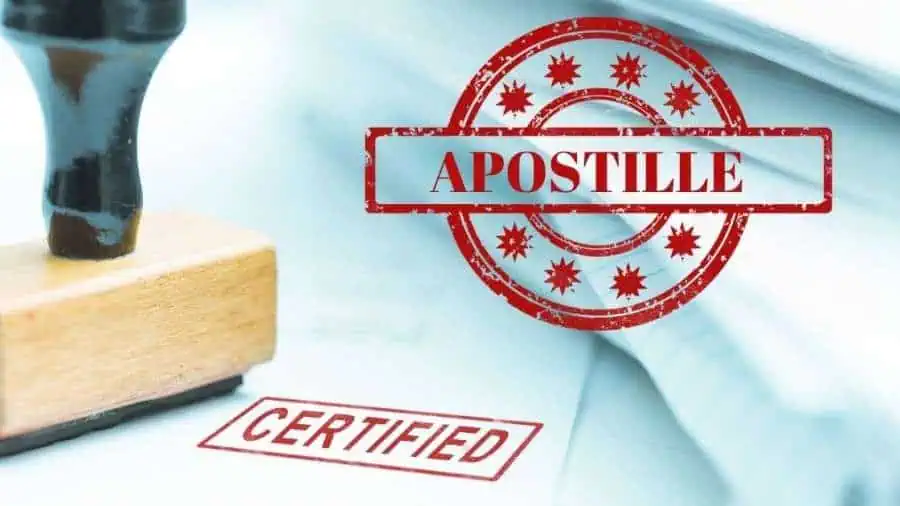
An apostille authenticates the signature and seal on the document itself. Illustration of the authentication step.
Documents issued by a U.S. state — or the District of Columbia, shown here — are apostilled by that jurisdiction's own authority.
Process
What happens between the request and the result.
Choose the award document (degree certificate or transcript) to be authenticated under the Hague Convention.
Apostille requests typically take 3 to 7 business days for state processing. The complete timeline, including notarization, certification and secure shipping, is typically 10 to 15 business days. Expedited handling may be available for an additional fee.
Documents ship in monthly batches on the 10th, with payment cleared by 10:00 AM EST on the 9th to make that month's batch.
Costs
Review the current fees, timelines and service details before you continue.
| Item | Amount |
|---|---|
| Apostille certification (Hague Convention) | $300 per document |
| Express processing, dispatched within 5 business days | +$299 |
| Remote-area shipping surcharge | +$75 |
Payment methods, installments and the full fee schedule are on the admissions page.
Questions
What employers, universities and graduates ask about this service.
ACLAS provides Apostille certification for degrees and academic transcripts. Each document is authenticated by the relevant state authority with the official Hague Apostille certificate attached.
Apostille processing typically takes 3 to 7 business days. Including notarization, certification and shipping, the complete service timeline is typically 10 to 15 business days. Expedited handling may be available for an additional fee.
More than 120 countries party to the Hague Convention. For non-member countries, additional steps such as embassy attestation or legalization may be required.
No. An apostille authenticates the document's origin, not the qualification's recognition. Recognition is a separate question decided by the receiving jurisdiction, institution or employer.
Other verification services
Different checks answer different questions. Most organizations need only one.
Every ACLAS award carries a unique certificate ID. Anyone holding that ID — an employer, an admissions office, an immigration authority — can confirm the award through a free public lookup.
Where an employer, university or immigration authority needs an arm's-length check rather than a self-service lookup, ACLAS credentials can be verified independently by Qualification Check in the United Kingdom.
The International Evaluation and Certification Center lists ACLAS credentials so that employers and universities can authenticate them instantly, and can issue a standardized evaluation report for a fee.
The service itself runs on the ACLAS campus, where it is connected to the student record system.